Executive Summary
When Salesforce launched AgentForce, expectations soared. Promoted as a low-code solution to deploy generative AI agents inside the Salesforce ecosystem, it quickly captured attention. However, the initial surge of excitement gave way to skepticism as teams discovered that implementing AgentForce agents at scale is anything but simple.
At Oktana, we’ve worked closely with Salesforce platforms—including Service Cloud, Data Cloud, and MuleSoft—for over a decade. We’ve seen this pattern before: new tech creates noise, but adoption stalls when internal teams hit architectural complexity, integration gaps, and governance concerns.
This paper outlines our proven approach to building AgentForce agents that actually work—securely, scalably, and with real ROI.
You’ll find practical examples, stats, and strategic insights for decision-makers and developers who are past the hype and ready to deliver.
- 🗣️ “Salesforce’s stock tells the story of the agent market itself. The hype was real, but adoption is slower than expected… Real traction comes when the technology integrates into workflows and delivers tangible wins.”
— Roei Haviv, Investor, Bessemer Venture Partners
1. What Slows AgentForce Adoption Today
Despite its potential, AgentForce faces widespread adoption challenges—particularly when organizations move from pilot to production.
Top barriers reported by the Salesforce community:
Obstacle | Reported by Users |
Difficulty managing prompt behavior | 78% |
Unreliable record context handling | 65% |
Lack of integration with existing flows | 60% |
Complex setup & poor documentation | 58% |
High expectations, low early returns | 51% |
- “You don’t replace humans with bots. You give the bots the mundane stuff and augment your team.”
— Muj Choudhury, RocketPhone.ai CEO

2. What Winning AgentForce Use Cases Look Like
Instead of chasing complex end-to-end automation, successful teams start with structured, bounded tasks that align with current workflows.
🔹 Top Use Cases We’ve Built at Oktana:
- 🔍 Email-to-Case Summary: An agent parses customer emails, extracts key metadata (e.g. job number, contact), and feeds it into case fields.
- 🧾 Eligibility Chat Assistant: Guided form logic handled via conversational interface to generate leads.
- 🧠 Case Intelligence: Agent reviews previous tickets and summarizes insights to accelerate resolution.
- 📸 Image Review Workflow: Agents assess photo submissions to validate customer claims.
📋 Automated Knowledge Drafting: Agents generate article drafts from resolved cases.
Each of these use cases reflects a hybrid approach, combining:
- Agent prompts
- Flow orchestration
- Apex logic for validation
Data Cloud for memory/context
3. How Oktana Designs AgentForce Systems That Actually Work
We’ve seen too many implementations fail because of:
- Overreliance on agents to “figure things out”
- Poor context handling in flows
- Prompts written like demos, not like production-ready tools
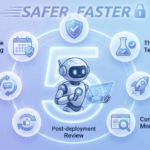
Oktana’s 5-Layer Agent Architecture:
Layer | Function |
🔧 Prompt Engineering | Modular, context-aware instructions with fallback logic |
🧩 Flow Integration | Agents embedded into screen flows or background flows |
🧠 Apex Intelligence | Guardrails, decision trees, and fallback mechanisms |
🔐 Data Governance | Permissions, logging, auditing, PII filtering |
📊 Evaluation Layer | Usage metrics, human-in-the-loop review, quality scoring |
- “Our clients don’t just want AI—they want reliability. Oktana delivers both.”
— Andrés Leiva, Solutions Architect, Oktana
4. Real Results from the Field
Here’s a before/after analysis from one client using an AgentForce integration designed by Oktana:
🧩 Use Case: Case Summarization Agent
Metric | Before AgentForce | With Oktana Integration |
Avg. time to summarize case | 9.4 minutes | 1.8 minutes |
Reopen rate | 11% | 3% |
Time to resolution | 48 hours | 22 hours |
Agent adoption | 12% | 73% |
- 🧠 “We replaced 7 manual steps with a single agent workflow that integrates perfectly into our daily operations.”
— Customer testimonial (anonymized)

5. Oktana’s AI Integration Advantage
We’ve spent 10+ years building on Salesforce, and we understand its limits.
What sets Oktana apart when working with AgentForce:
- 👩💻 Cross-functional teams: Prompt engineers, Salesforce-certified devs, QA, and architects all in-house.
- 🔄 Iterative prototyping: We test agent behaviors across edge cases using live and simulated data.
- 🔐 Privacy-first mindset: No hallucinations, no data leaks.
- ⚙️ Full stack automation: From flows to Apex to Mulesoft integrations, we connect all your systems.
Want to Explore What AgentForce Could Do for You?
We offer a free 30-minute strategy session to:
- Review your existing use case ideas
- Identify automation opportunities
- Define technical requirements
- Provide a roadmap to MVP agent deployment
🛠️ Let’s move beyond the hype—and build agents that deliver real outcomes.