
Industry data confirms this shift: 80% of North American companies now report considering nearshore providers (Bloomberg, 2025), while Latin America is forecast to add $78 billion to its outsourcing export sector following 2023 (IADB, 2025).
Nearshore software development teams also deliver tangible cost advantages, with rates averaging 46% lower than onshore equivalents (HatchWorks, 2025), alongside access to some of the most highly rated global developers (HackerRank, 2024).
Within this competitive environment, Oktana represents a distinct nearshore partner. Headquartered in the United States and with delivery teams across Latin America, Oktana specializes in Salesforce, MuleSoft, Snowflake, Databricks, and full-stack engineering. Unlike generic staffing firms, Oktana designs its services to function as extensions of client teams, integrating discovery, configuration, and continuous optimization into agile cycles that are both technically rigorous and responsive to business realities.
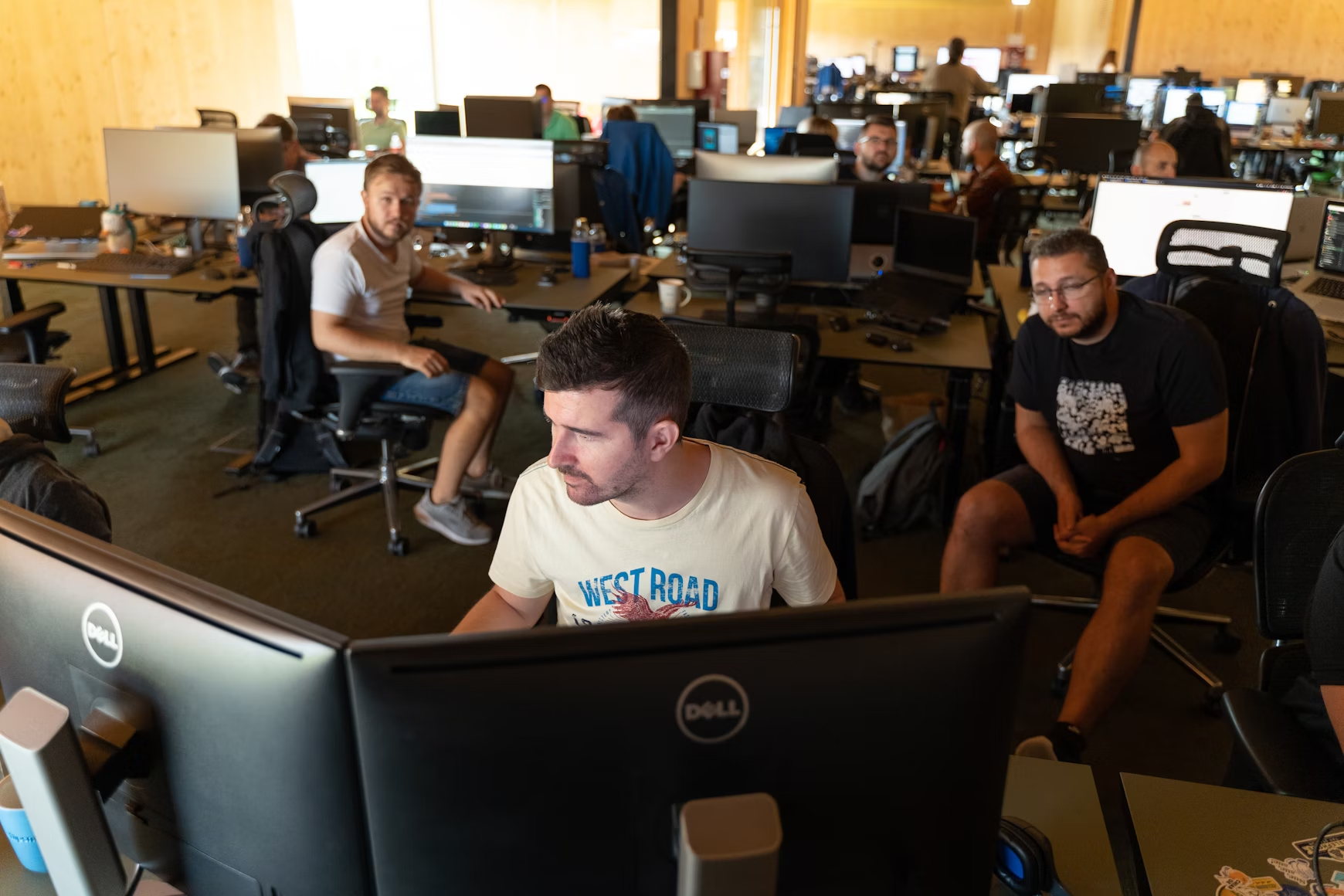
Project Implementation in a Nearshore Context
Scholars emphasize that firms often nearshore high-skill functions when control and collaboration are critical (Hahn et al., 2011). This explains why Oktana’s project implementation services—covering discovery, configuration, data migration, and integration—benefit strongly from nearshore alignment.
By running agile ceremonies in overlapping workdays, Oktana reduces the cycle time between client feedback and developer response. This is not a marginal gain. In distributed systems, rework can account for up to 30% of project cost when communication lags (Deloitte, 2023).
Nearshore Scrum teams address this problem directly. Oktana applies an iterative delivery framework, allowing stakeholders to refine requirements continuously and ensure that integrations—whether through MuleSoft APIs or Salesforce AppExchange apps—match operational needs.
Salesforce Optimization and Sustainable Value
Studies in technology management highlight that technical debt accumulation can reduce system agility and increase total cost of ownership by more than 40% over a five-year horizon (MIT CISR, 2022). Oktana’s Salesforce optimization practice tackles this problem by conducting org assessments, orchestrating flows, customizing applications, and reducing inefficiencies.
The nearshore model strengthens this work. Forbes Council (2024) emphasized that nearshore teams outperform offshore competitors in real-time problem solving because of cultural proximity and language alignment.
When applied to Salesforce workflows, automation, and third-party integrations, Oktana’s teams not only deliver technical fixes but also engage directly with business stakeholders to ensure adoption. This produces durable improvements rather than temporary patches.
Digital Engineering and Flexible Resourcing
The Deloitte Global Outsourcing Survey (2024) identified talent acquisition as the top challenge for 50% of executives. The demand for software engineers has more than doubled since 2020 (Hired, 2024), making staffing flexibility a strategic concern.
Oktana addresses this challenge with its digital engineering services, structured around a transparent time-and-materials model. Clients can scale teams rapidly—requesting, for instance, “two developers and one QA”—and receive resources aligned to their sprint velocity.
This practice reflects broader market trends: HatchWorks (2025) reports that 59% of companies now adopt nearshore development specifically to solve capacity issues and maintain agility.
Nearshore engineers in Latin America consistently score among the highest globally in HackerRank’s assessments, while regional English proficiency continues to rise at the fastest global rate (Education First, 2024). Oktana taps this talent pool, pairing technical expertise with cultural compatibility to reduce onboarding time and accelerate delivery.
Platform Expertise and Systems Integration
Nearshore outsourcing is not solely about staffing economics; it is also about platform specialization. Research on sourcing strategies underscores that firms increasingly seek partners with proven expertise in specific ecosystems rather than generalist vendors (Erber & Sayed-Ahmed, 2005).
Oktana exemplifies this trend through its multi-platform expertise:
- CRM Solutions: Tailored Salesforce implementations, custom communities, and training portals that extend customer engagement.
- Integrations: MuleSoft-based orchestration and custom APIs that unify enterprise data streams.
- AI & Data: Cloud-based warehouses and analytics environments in Snowflake and Databricks for business intelligence.
- Custom Development: Full-stack engineering across modern frameworks to deliver complete applications.

Case Evidence: Why Nearshore Works
Evidence from both academic and industry sources reinforces Oktana’s approach:
- Risk vs. Cost Trade-Offs: Hahn et al. (2011) found that firms tolerate higher wages in nearshore locations when protecting high-skill, IP-intensive work. Oktana applies this logic by assigning critical integration and data projects to nearshore teams.
- Operational Efficiency: Forbes Council (2024) highlighted that nearshore teams improve communication and reduce delays; Oktana’s long-term client relationships (averaging 4–5 years) validate the sustainability of this model.
- Market Adoption: HatchWorks (2025) reports that 80% of North American companies now consider nearshore, while Deloitte (2024) confirms 87% of IT leaders prioritize it for cost savings. Oktana operates directly within this growing preference, offering nearshore rates aligned with U.S. time zones.
Oktana leverages these dynamics to deliver tailored technology solutions in CRM, integrations, AI and data, and full-stack development.